CONNECTED POWER OPERATIONS
Connect generator, transfer, fuel, battery, alarm, and maintenance signals to a disciplined operating workflow. Remote visibility supports faster diagnosis, but local safety controls and qualified service procedures remain authoritative.
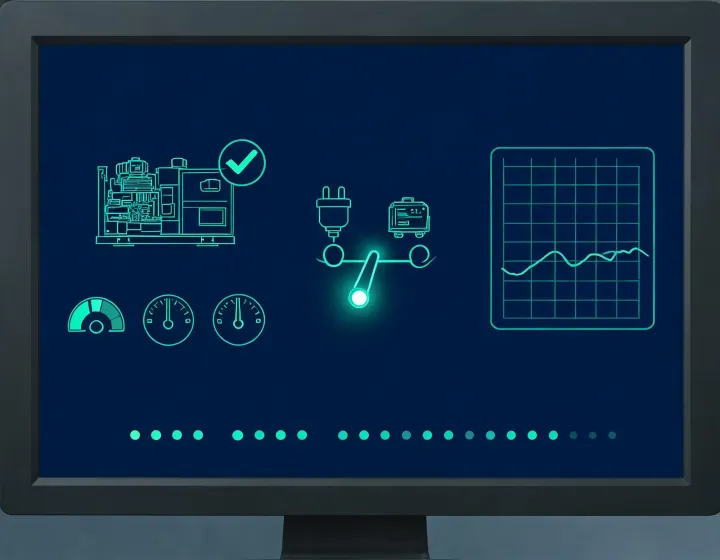
| Signal group | Decision supported | Required context |
|---|---|---|
| Engine and alternator | Confirm running state, voltage, frequency, load, temperature, and pressure trends. | Rated conditions, sensor quality, alarm thresholds, and controller timestamp. |
| Transfer sequence | Reconstruct utility loss, start command, source acceptance, transfer, retransfer, and cooldown. | Breaker positions, transfer settings, load steps, and event chronology. |
| Fuel and starting system | Schedule replenishment or battery service before readiness is compromised. | Tank geometry, consumption assumptions, charger state, ambient temperature, and test history. |
| Maintenance evidence | Prioritize inspection using run hours, exercise results, recurring alarms, and service records. | Qualified technician review and the applicable maintenance manual. |
Connected monitoring is strongest when every dashboard value can be traced to a physical point and every notification has an assigned action. A polished screen without tested alarm ownership can create false confidence. The final design must also respect electrical codes, privacy obligations, site IT policy, and manufacturer instructions for the exact controller and accessory set.
Send the generator and transfer-controller references, communications architecture, required data points, alarm recipients, retention policy, cybersecurity constraints, and commissioning criteria. We will help turn those inputs into a reviewable monitoring scope.
Map Monitoring Requirements